Masonry extraction and structural hardscape demolition demand specialized weight containment that standard municipal trash systems cannot legally transport. When breaking up an aged limestone retaining wall in Mount…
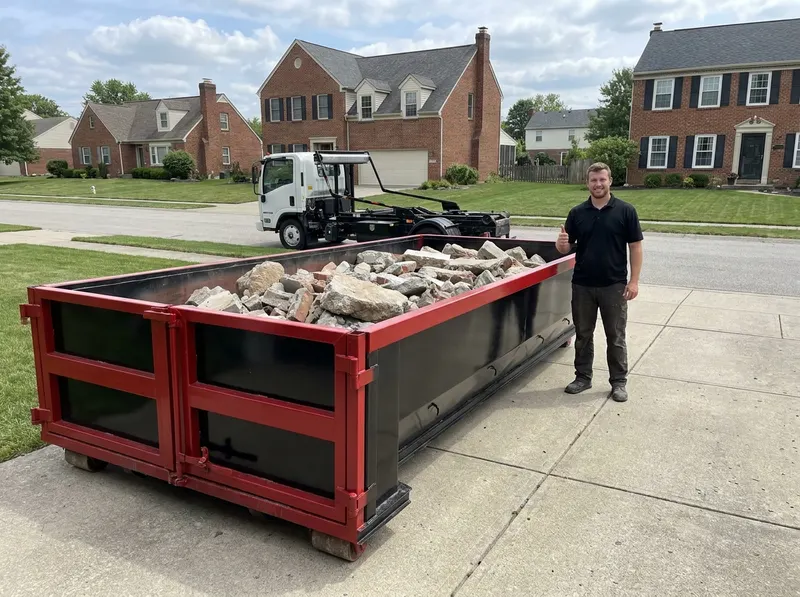
Masonry extraction and structural hardscape demolition demand specialized weight containment that standard municipal trash systems cannot legally transport. When breaking up an aged limestone retaining wall in Mount Adams or tearing out a cracked exposed-aggregate patio in Hyde Park, material weight compounds rapidly. A standard 10-yard volume of dense, dry cured concrete weighs approximately 10 tons. Standard trash bins fail under this stress or trigger massive roadside weight violations along Interstate 71. Dedicated concrete roll-off containers solve this logistical roadblock by utilizing reinforced subframes, lower sidewalls for ground-level wheelbarrow dumping, and dedicated dispatch direct to local inert aggregate recycling facilities. 1. Select the required footprint based on access width. 2. Dispatch routes your bin directly to the marked staging area. 3. Crew members wheel materials across the swinging rear tailgate. 4. Transport moves the loaded bin straight to processing yards.
Selecting the correct size requires balancing cubic volume against physical site clearance. For localized repairs, such as cutting out three broken driveway slabs in Oakley or rebuilding an entry stoop in Clifton, the 10-yard container at $595 offers the tightest footprint with minimal street footprint. If your site involves full commercial footing removal or multi-room plaster and brick tear-outs near Findlay Market in Over-the-Rhine, larger capacities allow continuous staging. The 15-yard is $650, the 20-yard is $695, the 30-yard is $795, and the 40-yard sits at $895. The trade-off centers on spatial constraints versus total tonnage volume: high-sided 30-yard and 40-yard containers require larger clearance paths from delivery trucks on narrow hillside inclines, while low-sided 10-yard and 15-yard bins make direct shovel-and-barrow loading over the rim far easier on worker fatigue.
Site preservation is central to operations across older neighborhoods like Walnut Hills and Northside. Steel wheels dragging across exposed aggregate or decorative paver driveways will gouge structural surfaces. Roll-off drivers place wooden runners beneath load-bearing contact points prior to releasing the cable tension. Clean aggregate loads must remain uncontaminated: mixing dimensional lumber, drywall scraps, or household trash into a dedicated masonry bin converts an inert recycling haul into mixed solid waste, fundamentally changing sorting protocols at regional transfer stations. Staging materials clean ensures rapid turnaround and maintains direct flat pricing for job sites from College Hill to Pleasant Ridge.
Every job gets a firm, written price after a free on-site visit.
Tell us about your heavy masonry & concrete roll-offs job in Cincinnati and we'll send a clear, written quote, usually the same day.
 Rapid Dumpster Rental